In a typical listing exchange service using Realty Vision,
all new listings and changes are entered into the system
by the listing agents. The hub computer merely collects
and redistributes data, operating unattended, eliminating
all paperwork, human labor, data entry errors, etc. which
characterize the conventional multiple listing operations.
- Minimum hub hardware needed is a 386 class personal computer with 4mb of memory, which
may be bought for literally a few hundred dollars nowadays. Its modem usage is so efficient
that, a single modem/phone line can easily serve dozens of offices/agents around the clock.
- Future revisions of Realty Vision may add support for up to 4 modem lines, without requiring
any special hardware beyond installing 1 to 3 more modems inside the hub computer. In case
more modems are needed, additional inexpensive PC's can be set-up as servers, for still less
than what it would cost to expand traditional multi-user computer hardware.
Realty Vision hub requires very little human attention per day,
a few minutes to do the daily process plus the time it takes to
do the daily data backups.
The hub operator never interferes with property data. The daily
process, which creates the hotsheets, etc. is fully automated,
requiring just a few mouse clicks. Operator interaction is only
needed occasionally, to maintain user access passwords, etc.
- In addition to or instead of the Realty Vision's built in backup functions, system backups can be
made more efficiently by using tape drives or other high capacity media instead of floppy disks.
- The daily process also allows the hub operator to include a non-private message of any length, to
be broadcast to all node users, as part of the following day's download files.
Hub software keeps track of all steps of the daily process, as
well as all the steps of communication sessions between the
hub and the user nodes, into two separate log files which can
be viewed and printed as needed.
In time, as the log files grow past a certain size, the operator
is reminded to edit these files to delete the older parts, which
may be done using functions available in the viewing screens.
- Access to Realty Vision hub is much more secure than with conventional on-line systems, simply
because the hub does not carry any conversations intelligible to humans, like asking user names,
ID's, passwords, etc. The hub answers calls and waits for calling nodes to initiate a proprietary
"hand-shake", not giving the would-be intruders any clues to even know where to start guessing.
Uploading and downloading to and from a Realty Vision hub
can also be done using floppy diskettes. This feature would
probably never be used on a regular basis but may save the
day in some cases, such as a user's modem breaking down
and taking several days to repair or replace. This is just an
example of the measures taken by Realty Vision in order to
protect its users from being stranded, even in the most rare
or unlikely situations.

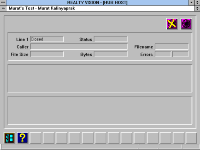
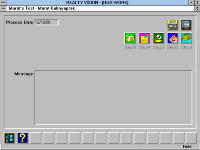 Realty Vision hub requires very little human attention per day,
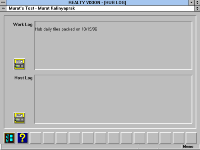 Hub software keeps track of all steps of the daily process, as
 Uploading and downloading to and from a Realty Vision hub